Kawasaki Heavy Industries has been commissioned by JERA to renovate safety and biomass fuel transport equipment at the Taketoyo coal-biomass power plant in Aichi Prefecture, Japan, following a 2024 fire that halted operations at the unit.
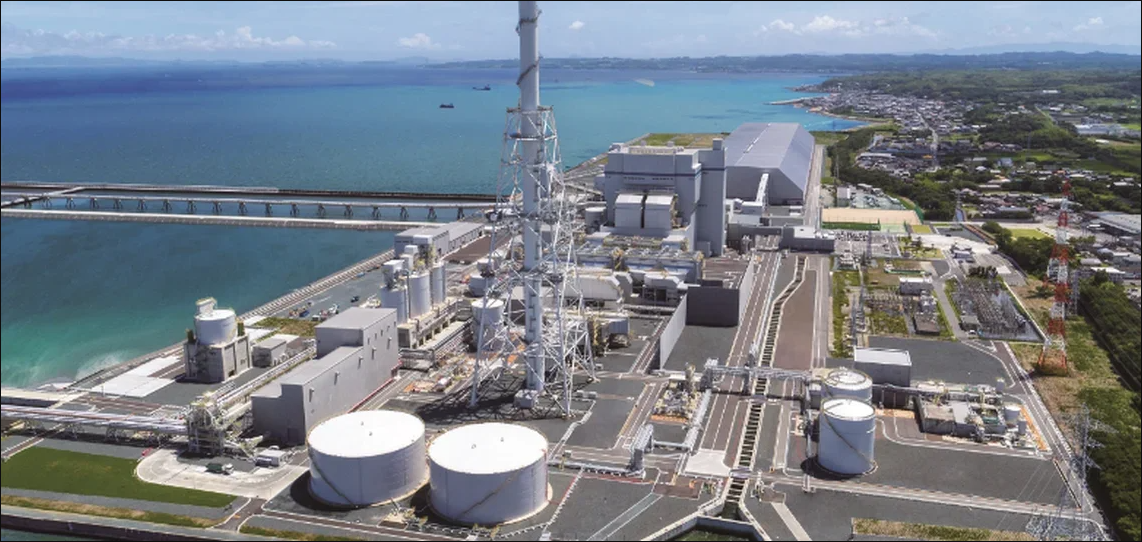
The order, announced on July 31, 2026, comes more than two years after the January 2024 incident. JERA, a joint venture equally owned by Tokyo Electric Power Company and Chubu Electric Power, describes itself as Japan’s largest power producer. Daily operations at the Taketoyo site are handled by its subsidiary, JERA Power Taketoyo GK.
The fire occurred near a biomass buffer storage facility located upstream of the boiler. According to the operator’s investigation, the incident was caused by a dust explosion, a known risk in biomass handling when fine particles accumulate and become suspended during fuel transport, creating a potentially explosive concentration. The operator reported no casualties.
After the incident, the operator chose a phased approach to restarting the unit, separating the resumption of coal-only power generation from the later return of biomass co-firing. It also said it intended to initially reduce the share of biomass in the fuel mix from the originally planned level before considering a gradual increase, subject to additional safety assurances.
The work assigned to Kawasaki Heavy Industries will focus on strengthening dust removal capacity and introducing operating methods better suited to biomass fuel handling. The contract also includes the installation of an additional protection layer combining early fire detection with rapid extinguishing measures.
These upgrades are aimed at addressing the specific cause identified in the 2024 incident: the accumulation of combustible dust. The findings did not point to a failure of the boiler itself or of the fossil fuel system.
The Taketoyo unit burns a mixture of coal and wood pellets, a configuration described by its operator as one of the largest of its kind in Japan. The co-firing plan, announced in 2017, is intended to reduce carbon dioxide emissions compared with coal-only operation while using existing thermal power infrastructure rather than building an entirely new fuel chain.