Researchers at the National Energy Technology Laboratory (NETL) have designed and tested a key component for rotating detonation engines (RDEs), an emerging combustion technology that could help make next-generation gas turbines more efficient, less fuel-intensive, and cleaner.
The work focuses on pressure gain combustion, a long-sought advancement in turbine technology.
Unlike conventional gas turbine combustion, which typically loses pressure during the combustion process, pressure gain combustion can increase pressure as fuel is burned.
This could significantly improve turbine performance while reducing fuel use and lowering nitrogen oxides emissions.
Detonation waves instead of conventional combustion
Rotating detonation engines operate in a fundamentally different way from today's turbine combustors. Instead of relying on conventional flame-based combustion, RDEs use rapidly moving detonation waves inside a chamber.
These waves release energy quickly and generate high-pressure pulses that can potentially improve overall engine efficiency.
"We could achieve pressure gain combustion with RDEs because they operate using detonation waves rather than conventional combustion used in today's gas turbines," said NETL's Justin Weber, who leads this project with his colleagues in the Lab's Advanced Turbines research team.
"Detonations release energy more rapidly, forming a high-pressure pulse and shock wave. But transitioning this concept into reliable hardware has long posed scientific and engineering challenges — particularly in ensuring stable, repeatable detonation under varying operating conditions," he continued.
That challenge has been one of the major barriers to turning RDEs from a promising laboratory concept into practical hardware for turbine-scale systems.
Computer modeling guides injector redesign
To address the issue, NETL researchers used high-fidelity computational fluid dynamics simulations to redesign the injector that delivers fuel and air into the detonation chamber.
Earlier injector concepts suffered from startup instabilities, making it difficult to reliably generate and sustain the detonation waves needed for RDE operation.
The team used CFD modeling to examine how injector geometry, flow distribution, and fuel-mixing behavior affected wave formation.
This approach helped researchers develop a novel-aero strut injector configuration. According to NETL, the new design can sustain detonation waves while producing a lower pressure drop across the injector, improving performance.
The research demonstrates how advanced modeling can accelerate hardware development by reducing reliance on trial-and-error testing. It also gives researchers a deeper understanding of how combustion dynamics change under extreme operating conditions.
Stable waves confirmed in testing
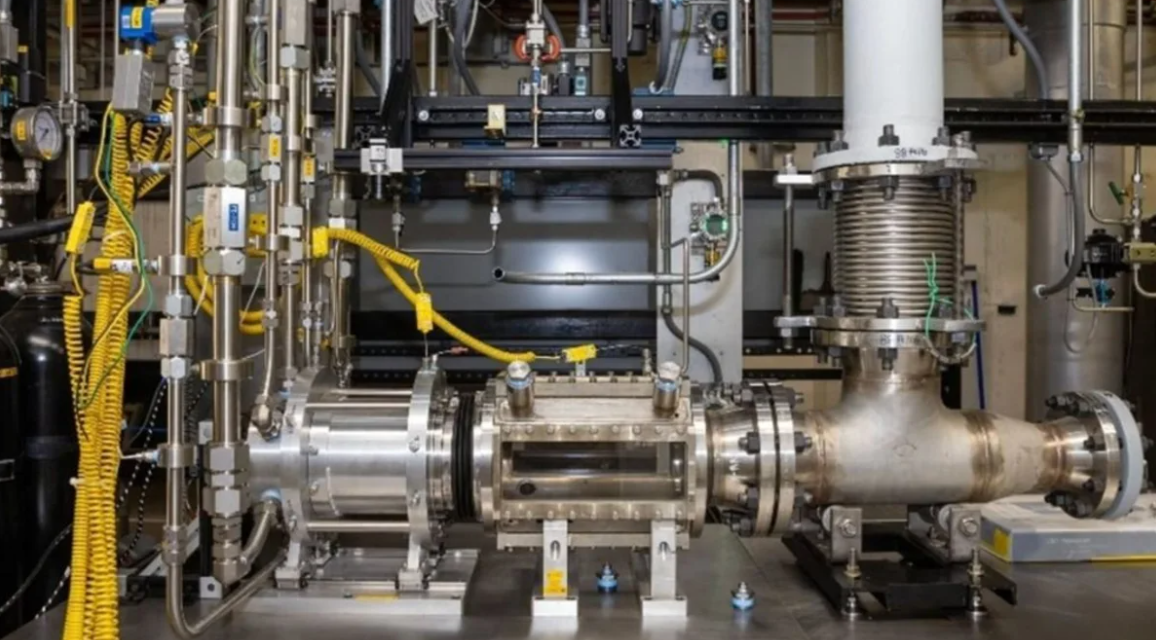
NETL then tested the redesigned injector using its water-cooled RDE test platform, a research rig built to withstand extreme thermal loads during high-pressure detonation.
"To validate the new design, we integrated the injector into NETL's water-cooled RDE test platform — an advanced research rig designed to withstand extreme thermal loads during high-pressure detonation," Weber said.
The result directly supports NETL's Advanced Turbines Program, which is focused on maturing pressure gain combustion and reducing technical risks for next-generation gas turbines.
A stable injector is considered a critical building block for practical RDE-based systems. By demonstrating consistent detonation behavior across multiple conditions, NETL has moved the technology closer to real-world deployment.
Researchers now plan to continue refining RDE components and exploring integration with turbine hardware, with the goal of eventually bringing pressure gain combustion from the laboratory into commercial energy infrastructure.