National Institutes for Quantum Science and Technology (hereinafter “QST”) and NTT, Inc. (hereinafter “NTT”) have successfully realized fast frequent, real‑time communications essential for the rapid prediction and control of plasma in fusion reactors.
Since signing a collaboration agreement in 2020, QST and NTT have been conducting joint research aimed at creating fusion energy technology—world leading innovative environmental energy.
To stably confine the high‑pressure plasma required for a fusion reactor, it is essential to control rapidly growing plasma instabilities within an extremely short timeframe—less than 1/10,000 of a second. At the same time, the expansion of facility scale and the increasing complexity of control logic require longer‑distance communication between computers within the control network, along with larger communication data volumes.
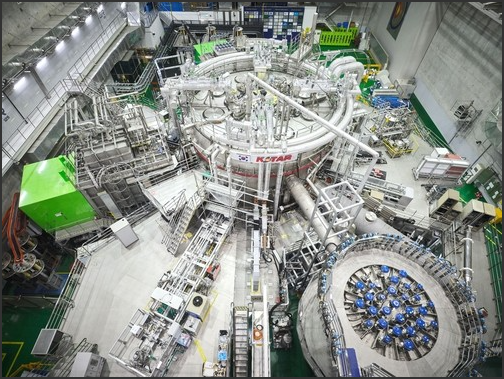
However, with conventional technologies, achieving such fast frequent real‑time communication within less than 1/10,000 of a second—over the required distances and with the expected data volumes—has been difficult. For JT‑60SA, the world’s largest superconducting tokamak experimental device, design efforts have been underway to establish a dedicated network capable of supporting this level of fast frequent real‑time communication. In this context, deterministic fast frequency communication technology suitable for use within the control system has now been established, and a demonstration test of the technology has been conducted. As a result, fast frequent data communication at intervals shorter than 1/10,000 of a second—previously unattainable with conventional technologies—has been successfully achieved for the first time in the world.
This achievement is indispensable for advancing real‑time control of high‑pressure plasma in upcoming heating experiments on JT‑60SA. Moreover, it represents a groundbreaking step toward real‑time predictive control in fusion reactors such as ITER and future DEMO reactor, where significantly larger plasmas must be predicted and controlled using a limited number of diagnostic instruments and a large network of control computers. Building on this accomplishment, QST and NTT will further strengthen their collaboration and continue working toward the early realization of fusion energy.