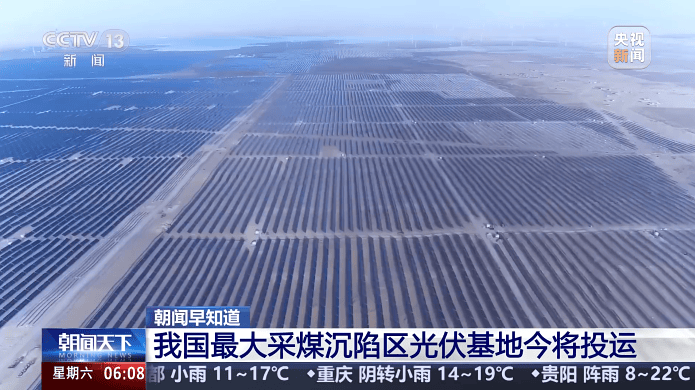
The development of desertified areas is a national-level strategy that leverages the unique resource and land endowments of China's "Three North" regions to achieve synergistic development of ecology and energy. Constructing large-scale hybrid energy bases in these desertified areas can address the contradiction between China's energy resources being concentrated in the west and the load centers being in the central and eastern regions. By utilizing ultra-high voltage transmission channels for "west-to-east power transmission," it optimizes national energy allocation, builds a stable clean energy supply system, and combines photovoltaic sand control to reduce wind speed and evaporation, thereby rehabilitating desertified land.
The Ningxia 6 GW hybrid photovoltaic base project in coal mining subsidence areas consists of the Ningdong 2 GW hybrid photovoltaic base and the Ningxia Lingwu 4 GW hybrid photovoltaic base, which are components of the first and second batches of large-scale wind and photovoltaic bases in desertified areas during China's 14th Five-Year Plan period, respectively. The total project area is equivalent to approximately 16,000 football fields, and it includes the construction of six 330 kV booster stations and 200 kilometers of transmission lines. Once fully completed and operational, the project can meet the annual electricity needs of 7.2 million households, save about 3.24 million tons of standard coal annually, and deliver significant economic, social, energy-saving, and environmental benefits. It makes an important contribution to helping China achieve its carbon peak and carbon neutrality goals and promoting ecological protection and high-quality development in the Yellow River Basin.
As a vivid practice of the new power system, the project includes supporting energy storage of 600 MW/1200 MWh, with 400 MW/800 MWh already completed. The project has conducted research on key technologies to enhance the active support capability of new energy stations, employing grid-forming energy storage technology. Together with the thermal power supporting the Lingshao DC line, it forms an "PV-thermal-storage-hydrogen" energy export base. Specifically, the Lingwu Phase II 2 GW photovoltaic project adopts a complementary bundling export model of photovoltaic and thermal power. Leveraging the flexible regulation capability of the thermal power supporting the "Lingshao DC" line, it effectively mitigates the output volatility of photovoltaic power generation, significantly enhancing the stability of new energy exports.
Simultaneously, the project pioneered a domestic approach for new energy integration by expanding the existing 750 kV booster station of a nearby thermal power plant for power export. By constructing two new 330 kV outgoing lines and expanding with one 2100 MVA main transformer, it has completely opened up a "high-speed road" for green power export.
This innovative export model achieves efficient sharing of thermal power export channels. It provides a replicable, scalable, and exemplary demonstration sample for the efficient grid connection and intensive export of large-scale new energy bases in desertified areas nationwide, leading new energy grid connection and export technology into a new stage.