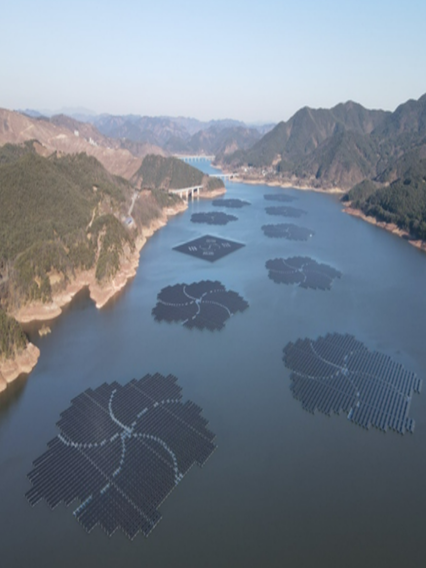
Plans for the project originated in 2021, when the site was designated as South Korea’s first renewable energy integrated complex. Electricity business approval was granted in 2023, and construction of the solar system started last year. The project was completed in late September, with total costs reaching KRW 73.2 billion ($50.2 million).
The development was carried out by Korea Hydro & Nuclear Power (KHNP), Korea Water Resources Corporation, Gyeongsangbuk-do Province, and Andong City. Top Solar served as the engineering, procurement, and construction contractor. Scotra, a Seoul-based company specializing in floating solar structures, supplied the floating platforms. The solar modules were provided by Korean manufacturer Shinsung E&G.
The installation comprises 16 floating structures arranged in patterns inspired by the Taegeukgi, the national flag of South Korea, and Mugunghwa, the national flower. The combined solar-hydro complex is projected to generate about 61 GWh of electricity annually. This output is expected to supply roughly 22,000 households, representing around 27% of all households in Andong.
A spokesperson for Scotra told pv magazine that the project uses a resident-participation model through which 33 local villages invested via a dedicated legal entity. The spokesperson said: “Over 20 years, approximately KRW 22.2 billion in revenue will be returned to the community.” The model, sometimes referred to as a “Sunlight Pension,” is expected to support household income and contribute to economic activity in the region.
Information published on KHNP’s website indicates that the initiative will benefit approximately 4,500 residents living within a 1-km radius of the project, allowing them to share in profits generated by the power supply. Local participation is a key component of the project structure, aligning with national efforts to expand renewable energy while promoting community involvement.
South Korea installed 2.5 GW of new solar capacity last year, pushing cumulative PV capacity to more than 29.5 GW, according to data from the Korean Energy Agency. The new floating plant at Imha Dam adds a distinctive component to the country’s continued expansion of solar power and demonstrates an integrated approach that leverages existing hydropower infrastructure for renewable energy production.