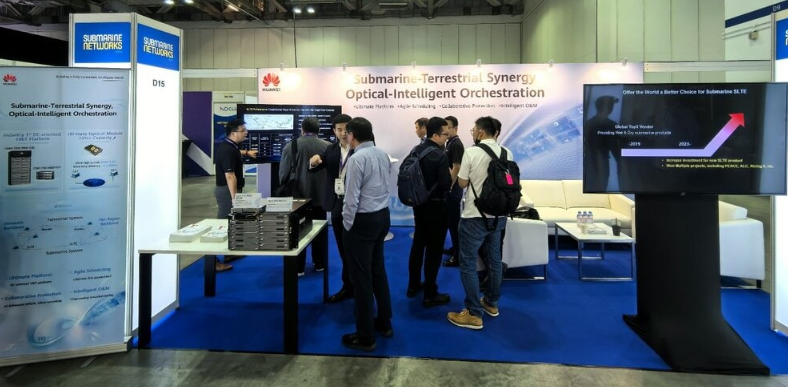
Huawei’s exhibition booth at Submarine Networks World 2025 in Singapore
Huawei’s strategy moves beyond traditional network designs, where submarine and terrestrial systems operate independently with limited interoperability. By integrating these networks, the solution supports cross-domain resource visualization, coordinated service protection, and intelligent O&M, improving overall network performance and service delivery.
A highlight of the showcase was the OptiX OSN 9800 K series, the industry’s first data-center-oriented platform for integrated submarine and terrestrial networks. This platform offers a unified architecture, supporting both network types with a service processing capacity of 4T per slot, up to 100T+ per chassis, and 96T per fiber. Its design emphasizes energy efficiency, reducing per-bit power consumption to 0.1 W/Gbit, 65% below the industry average. The platform also incorporates intelligent O&M through digital twin technology, enabling proactive operations and increasing efficiency by 40%.
Huawei also introduced a 1.6T board for submarine line terminal equipment (SLTE), offering adjustable rates from 300G to 1.6T and transmission distances up to 11,000 km. This advancement enhances the capacity and performance of submarine networks, meeting the growing demands of global connectivity.
Gavin Gu, President of Huawei’s Optical Transmission Domain, stated: “Huawei plans to build an integrated submarine-terrestrial network architecture featuring ultra-broadband, high reliability, agile and intelligence, so as to enable seamless transmission while significantly enhancing network O&M efficiency and service quality through intelligence.”
With 30 years of expertise in optical transmission, Huawei’s innovations support the increasing global demand for robust communication networks, driven by digitalization and intelligent transformation. The company’s solutions aim to strengthen the submarine network industry, a critical component of global connectivity, by improving capacity, reliability, and operational efficiency. These advancements are expected to foster sustainable growth in the communications sector, benefiting service providers and end-users worldwide.