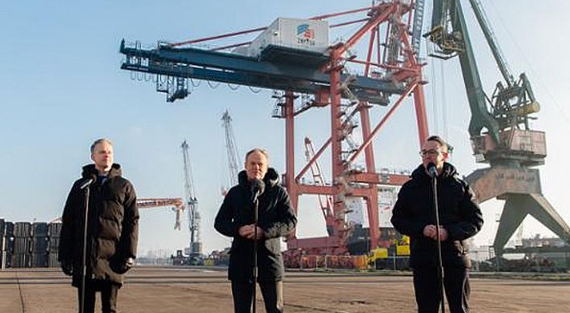
The Gdańsk Agro Terminal, a key investment planned for 2025–2028, aims to meet the demands of the agri-food market and enhance export capabilities. The project’s first phase (2025–2026) includes building a 7,000 m² flat warehouse on Szczecińskie Quay with a 30,000-tonne capacity. The second phase (2026–2028) will develop a 100,000-tonne capacity complex of flat-bottomed steel silos on Wiślane Quay, alongside a ship loading and unloading system capable of processing 1,000 tonnes per hour. Integrated with the port’s rail, road, and cargo infrastructure, the terminal will significantly improve logistical efficiency.
With a total storage capacity of 160,000 tonnes, the terminal will quadruple the port’s current grain storage of 35,000 tonnes and increase annual handling from 0.7 million to 3 million tonnes. Andrzej Kuźmicz noted: “This project is designed to address grain market volatility caused by geopolitical factors and climate change, creating a flexible, scalable infrastructure to ensure the Port of Gdańsk’s resilience to supply and demand fluctuations.” Funded entirely by national resources, the initiative supports long-term infrastructure stability in Poland.
The terminal will employ advanced automated systems for efficient grain handling from hopper wagons, trucks, and ships. The Szczecińskie Quay warehouse will feature automated loading and unloading, technological bridges, continuous transport equipment, and dust reduction systems, ensuring compatibility with rail and road transport. Eco-friendly technologies will minimize dust, reduce fire risks, and preserve grain quality, addressing environmental and operational needs.
The GAT project, costing PLN 240 million, allocates 38% to technology and 33% to construction. The first phase, costing PLN 13.8 million, is funded by PGE, while the second phase, involving silo construction and Wiślane Quay integration, is in the feasibility study stage. Dorota Pyć, President of the Port of Gdańsk, stated: “This project will boost the port’s competitiveness and Poland’s position as a grain export leader, aligning with the comprehensive redevelopment of Wiślane Quay planned for 2025–2028.”
The Gdańsk Agro Terminal strengthens the port’s role in global agri-food markets, enhancing efficiency and sustainability through modern infrastructure and strategic investments.