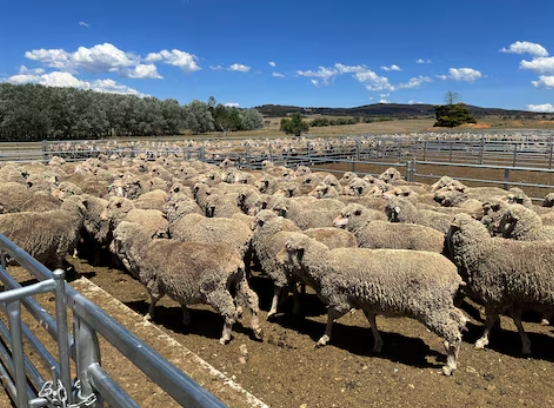
Sheep run into a holding pen at a farm near Delegate, in New South Wales, Australia, November 19, 2023.
Matt Dalgleish, a livestock and meat analyst at consulting firm Episode 3, stated: “We've seen waves of higher and higher pricing as export demand and our market share has grown.” He noted that although seasonal price fluctuations are expected, the current combination of strong demand and constrained global supply supports continued optimism for Australian producers.
In 2024, Australia exported 702,000 metric tons of lamb, mutton, and goat meat, valued at $3.6 billion. This was nearly 200,000 tons more than in 2019, the previous record year. Trade data for the first four months of 2025 show that shipments have already increased by 10% compared to the same period in 2024.
Driven by processors' demand, the price of heavy lambs recently reached nearly A$11 ($7.14) per kilogram, a 50% increase from the same time last year. The data comes from a national price indicator maintained by Meat & Livestock Australia (MLA), the industry’s representative body.
China remains the largest importer of Australian sheep meat, followed by the United States, Britain, the European Union, and countries in the Middle East. Dalgleish explained that rising incomes and population growth in many regions are driving increased consumption of lamb and mutton. He also highlighted that elevated beef prices, especially in the U.S., are leading consumers to seek more affordable protein options, contributing to the shift toward sheep meat.
Australia's position in the global market has been further strengthened by a decline in sheep production in New Zealand, traditionally its closest competitor. MLA data shows that Australia and New Zealand together account for over 80% of global sheep meat exports. However, while Australia's sheep population has grown in recent years, New Zealand’s flock has been in continuous decline since 2012. According to New Zealand's statistics agency, part of this reduction is due to farmland being converted into pine plantations, which generate carbon credits.
Angus Gidley-Baird, an analyst at Rabobank, commented: “New Zealand is the other major global exporter. Its production is stagnating or retracting. So any growth in global demand is Australia's opportunity for the taking.”
As global consumption trends continue to evolve, and supply from key competitors remains limited, Australian sheep producers appear well-positioned to maintain their momentum in the export market.