The UK's Office for Nuclear Regulation (ONR) has officially approved the relicensing of the Hunterston B nuclear power plant in North Ayrshire, Scotland, transferring the license from EDF to Nuclear Restoration Services (NRS). This marks the start of the site's decommissioning phase.
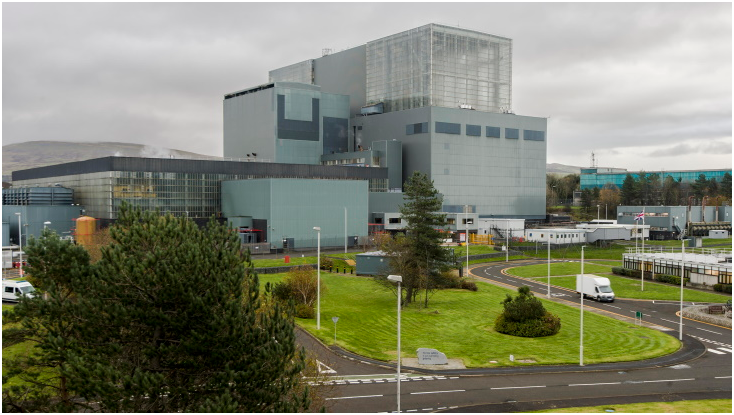
Hunterston B (Image: EDF Energy)
The plant is set to be transferred to the Nuclear Decommissioning Authority (NDA), responsible for decommissioning the UK's former nuclear sites, on 1 April. NRS, an NDA subsidiary, will become the new licensee and take full responsibility for overseeing the decommissioning, making Hunterston B the first of EDF's Advanced Gas-Cooled Reactor (AGR) sites to move to NRS.
During a signing ceremony at Hunterston B on Wednesday, the ONR granted a site license to NRS and signed documents revoking EDF's license effective from 31 March. The new license, which takes effect at the point of site transfer, is a legal document outlining the conditions for site operation and is crucial for future decommissioning work.
The NDA stated that the change in ownership is expected to occur on time and within budget, involving the transfer of thousands of files and records, over 20 contracts, and six site licenses and permits from EDF to NRS.
The Hunterston B plant consists of two 490 MWe AGRs, Reactors 3 and 4. Reactor 3 came online in February 1976, initially expected to run for 25 years but extended to over 45 years. It was taken offline in November 2021. Reactor 4 started up in March 1977 and was shut down in January 2022. In April last year, Hunterston B became the first of the UK's seven AGR power plants to be declared free of all used nuclear fuel ahead of decommissioning.
Decommissioning will involve dismantling nuclear facilities and removing associated radioactive waste for safe storage or disposal, including removing all plant, equipment, services, and buildings outside the reactor building. After completion, the site will enter a period of care and maintenance. The decommissioning is funded by the Nuclear Liabilities Fund, a ring-fenced GBP20.7 billion (USD27.6 billion) fund set up in 1996 for this purpose.
Originally, EDF was responsible for the total lifetime decommissioning of the seven AGR plants, which include Torness and Hunterston B in Scotland, Dungeness B in Kent, Hartlepool in Teesside, Heysham 1 and 2 in Lancashire, and Hinkley Point B in Somerset. All these plants are scheduled to reach the end of their operational lives this decade.
However, in June 2021, the UK government and EDF agreed on improved arrangements to safely and efficiently decommission the AGRs. Under the agreement, EDF will aim to shorten the time it takes to safely remove fuel from the plants as they come offline, before working closely with the NDA to transfer ownership of the stations.
Currently, four AGR plants are still in operation. Hartlepool and Heysham 1 are expected to operate until March 2028, while Heysham 2 and Torness are due to generate until March 2030.