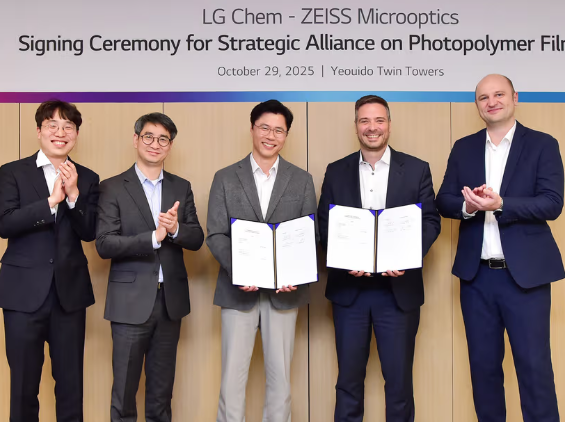
The agreement was formalized at LG Chem’s Yeouido Twin Towers, attended by senior representatives from both companies, including Stephan Höfer, Senior Vice President and Head of Business Development and Marketing at ZEISS Microoptics, Dr. Viktor Schütz, Vice President and Head of Partnership Management at ZEISS Microoptics, and Ko Kyung-deok, Vice President and Head of Electronics Materials Business Unit at LG Chem. Under this agreement, LG Chem will supply photopolymer films within the ZEISS Microoptics Enabling Ecosystem to support their integration into automotive windshields. The first mass production for automotive manufacturers is targeted to begin in 2029.
Through this cooperation, ZEISS and LG Chem aim to strengthen material supply stability for the emerging holography industry. Their joint efforts will support a range of applications in mobility, holographic sensor systems, and consumer technologies. By synchronizing supply chain management and inventory operations, the companies will ensure consistent availability of materials and uninterrupted support for ongoing and future production programs worldwide.
The partnership extends beyond the delivery of materials. ZEISS contributes its expertise in holography, microoptics, and precise application development, while LG Chem focuses on advanced material research and manufacturing. The collaboration follows a co-development model that allows both companies to adapt quickly to evolving customer demands and market trends. This approach promotes agile development, effective communication, and faster technological adaptation, ensuring a continuous supply of high-performance optical and holographic materials.
LG Chem brings decades of experience in chemical development, polymer synthesis, liquid formulation, and precision coating, achieving high optical efficiency and thermal stability backed by more than 150 patents. ZEISS guarantees global traceability and transparency within its Microoptics Enabling Ecosystem, while LG Chem emphasizes responsible sourcing and energy-efficient production processes. Together, they ensure that each photopolymer film meets strict performance, reliability, and regulatory standards.
In the automotive sector, photopolymers serve as a key component for Holographic Windshield Displays, a next-generation technology that transforms windshields into transparent, multifunctional displays for navigation, driving data, and entertainment.
Dr. Viktor Schütz stated: “With LG Chem at our side, the ZEISS Microoptics Enabling Ecosystem will deliver reliable, advanced photopolymers at scale for transparent displays in automotive. By focusing together on innovation, technical standards, and supply continuity, we help customers tackle the toughest optical challenges in automotive and beyond.”
LG Chem CEO Shin Hak-cheol added: “Our partnership with ZEISS is a strategic collaboration aimed at securing competitiveness based on optical technologies, beyond mere material supply. LG Chem will lead the innovation of automotive displays with differentiated optical material technologies.”